
opera
February, 2013 Desktop Market Share: Internet Explorer, Firefox, Safari, Opera Up; Google Chrome Down
If yesterday’s mobile browsers data is not exactly your cup of tea then we have another solution for you and it’s all about the desktop. As you might have guessed from the title, February was a pretty interesting month indeed. Starting off with Internet Explorer, Microsoft’s web browser continues to rebound its losses, up from [...]
- Add new comment
- 739 reads
- Feed: Web Browsers News and Reviews
January, 2013 Mobile Market Share: Safari, Google Chrome, Internet Explorer – Up; Opera Mini, Android – Down
As the “New Year” passes by, it’s time to take a look at the mobile market share data for January, 2013, which includes one new player: Internet Explorer.
- Add new comment
- Read more
- 3203 reads
- Feed: Web Browsers News and Reviews
December, 2012 Desktop Market Share: Internet Explorer, Google Chrome, Opera - Up; Firefox, Safari - Down
When you look back, in 2011 a lot of people thought that Internet Explorer was pretty much doomed and that Google Chrome and Firefox will dominate the desktop space for an indefinite amount of time. Well, look how things have change… or did they? Steady as she goes, Internet Explorer is up again, from 54.76% [...]
- Add new comment
- 853 reads
- Feed: Web Browsers News and Reviews
Mobile Browser Benchmarks: Android Browser 4.1 vs. Google Chrome 18 vs. Dolphin 9 vs. Firefox 17 vs. Maxthon 1.7 vs. Opera Mobile 12.1 vs. Sleipnir 2.5
Now here is something for the Android users. Guys from TomsHardware took massive list of Android 4.1 (Jellybean) supported web browsers and tested all of them. If you got confused by too many alternatives, this article should give you a pretty good indicator on who’s leading and who’s lagging in this area. You will be [...]
- Add new comment
- 3696 reads
- Feed: Web Browsers News and Reviews
November, 2012 Desktop Market Share: Internet Explorer, Firefox, Safari, Opera - Up; Google Chrome - Down
It’s the last month of the year as we check the market share results for November. Were there any surprises? Let’s find out. It looks like Internet Explorer wont slide below the 50% mark for quite some time as its market share continues to edge higher, up from 54.13% to 54.76% (0.63 point increase). Mozilla’s [...]
- Add new comment
- 1105 reads
- Feed: Web Browsers News and Reviews
Windows 8 Benchmarks: IE10 vs. Firefox 16 vs. Google Chrome 23 vs. Opera 12.1
With Microsoft publishing a developer preview version of Windows 8 back in 2011, it’s time to find out, which (if any) of the web browser companies actually did their homework and optimized the software for the latest OS. Web Browsers Internet Explorer 10 Firefox 16 Google Chrome 23 Opera 12.10 Benchmark Results Conclusion Overall, a [...]
- Add new comment
- 547 reads
- Feed: Web Browsers News and Reviews
September, 2012 Desktop Market Share: Internet Explorer, Firefox, Safari, Opera - Up; Google Chrome - Down
After publishing the market share report for the mobile web browsers, it’s time to reveal a real thing: desktop. As we are weeks before the launch of the Windows 8, Microsoft’s Internet Explorer managed to increase its market share by 0.03 point, up from 53.60% to 53.63%. Just like IE, Mozilla’s Firefox has also increased [...]
- Add new comment
- 819 reads
- Feed: Web Browsers News and Reviews
Benchmarks: IE10 vs. Google Chrome 21 vs. Firefox 15 vs. Opera 12
RoboHornet Alpha 1. Just yesterday, Google has launched an open source benchmark tool called RoboHornet, which according to the search giant itself, “encompasses all aspects of browser performance and everything that matters to web developers, like performance of layout and localStorage”. Now, before you get all cranky and claim that it’s just another useless test [...]
- Add new comment
- 1063 reads
- Feed: Web Browsers News and Reviews
August, 2012 Desktop Market Share: Google Chrome, Safari – Up; Internet Explorer, Firefox, Opera – Down
As the summer passes by, it’s time to find out, how exactly did your favorite web browser perform in the month of August. Starting with the Internet Explorer, we resume the long and unsurprising downtrend, down from 53.93% to 53.60% (0.33 point decrease). After a couple of good months, Firefox too continues its downtrend, down [...]
- Add new comment
- 779 reads
- Feed: Web Browsers News and Reviews
Internet Explorer 10 (IE10) vs. Firefox 15, 14 vs. Google Chrome 23 vs. Opera 12.5
As we have reported earlier, Google has decided to create a yet another JavaScript benchmark and after publishing some preliminary browser results from other sources, we have decided to do a test of our own. Web Browsers Internet Explorer 10 Release Preview (Build 10.0.8400.0) Firefox 14 (Version 14.0.1) Firefox 15 Beta 5 Google Chrome 23 [...]
- Add new comment
- 1473 reads
- Feed: Web Browsers News and Reviews
July, 2012 Desktop Market Share: Firefox, Safari - Up; Internet Explorer, Google Chrome, Opera - Down
Another month, another market share report and this time it’s for the desktop web browsers. With the upcoming release of IE10, Internet Explorer continues to lose its market share, down from 54.02% to 53.93% (0.09 point decrease). After a streak of market share loses, it looks like Firefox has recovered and has since increased its [...]
- Add new comment
- 565 reads
- Feed: Web Browsers News and Reviews
Benchmarks: IE9 vs. Firefox 13 vs. Google Chrome 20 vs. Opera 12 vs. Safari 5.1
Yes, we will finally post this. With a release of new web browser builds, including Chrome 20 and Firefox 13, guys at the TomsHardware have yet again dome a good job ad benchmarking all of them. Who will win? Check the results below to find out.
- Add new comment
- Read more
- 3547 reads
- Feed: Web Browsers News and Reviews
Five Best Android Web Browsers

There are dozens of great web browsers available for Android, depending on the features you're looking for. Whether it's syncing with your desktop, or super-speedy browsing, or support for flash navigation, you have options galore—some of them popular, others not so much. This week we're going to look at five of the best Android browsers, based on your nominations. More »
- Add new comment
- 951 reads
- Feed: Lifehacker: Google Chrome
June, 2012 Market Share: Firefox, Safari, Opera - Up; IE, Google Chrome - Down
Well, here is an interesting turn of events, a somewhat inverted market share data.
Instead of focusing on the user experience and eliminating the useless 2 year release cycle, IE team has decided to fire more ads instead. Certainly, even great ads have their limits and as shown above, Internet Explorer continues to lose its market share, down from 54.05% to 54.02% (0.03 point decrease).
After following IE’s trend ever since the release of the Google Chrome, Firefox has managed to take back some of its share and is now back slightly above the 20% mark, up from 19.71% to 20.06% (0.35 point increase). Is it a dead cat’s bounce or the beginning of a new trend?
All good things come to an end and as shown in the graph above, Google’s Chrome web browser growth is slowing down, at least for a little while. This time its market share has decreased by a 0.5 point, down from 19.58% to 19.08%.
After grinding lower for a couple of months, Safari is bouncing back, up from 4.62% to 4.73% (0.11 point increase).
Just like Safari, Opera has struggled to gain a significant momentum for quite some time now. However, last month its market share has increased by a 0.03 point, up from 1.57% to 1.60%.
- Add new comment
- Read more
- 4059 reads
- Feed: Web Browsers News and Reviews
 More fuel to the rumor’s fire.
It looks like Facebook management decided not to bother with the Google Chrome anymore as their latest “” page has since then removed the search giant’s web browser.
If you haven’t been living under a rock for the last few days, chances are, you’ve heard about the social giant’s .
Well, guess what, Facebook now recommends Opera over the Google Chrome and yes, let the speculations begin.
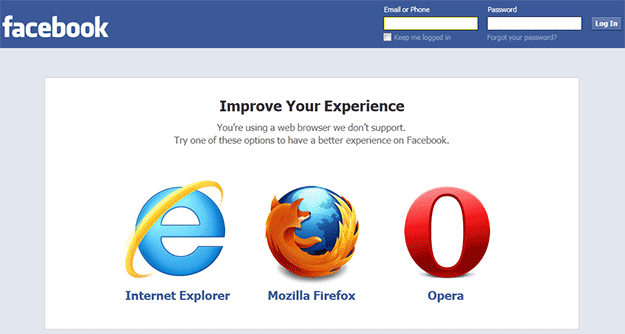
Cached Google Page Shows Interesting Changes
- Add new comment
- 349 reads
- Feed: Web Browsers News and Reviews
Google Chrome Tab Stacking
I’m not really sure when Google introduced the tab stacking feature in the Google Chrome browser, only that it is available at least in the Windows Chrome Canary builds right now. Tab stacking basically allows you to stack tabs on top of each other to save screen estate when the tab count reaches a level where the browser would originally resort to scrolling.
If I’m not mistaken, it was Opera that introduced tab stacks in version 11 before any other browser. I personally think that all major browsers will eventually introduce a tab stacking feature eventually as it offers a great way of saving screen estate in the tab bar if multiple pages on the same domain name are open in the Internet browser.
Back to Google Chrome and the browser’s tab stacking implementation. The feature is currently only available via the chrome://flags list of experimental features. Just load chrome://flags/ in the browser’s address bar, hit F3 and enter stacked tabs in the on-page search form to find the parameter immediately on the page.
It reads: Stacked Tabs. Tabs never shrink, instead they stack on top of each other when there is not enough space.

Click on the Enable link and restart the browser to enable tab stacking in Google Chrome. If you have tried Opera’s tab stacking functionality before, you will notice that Chrome’s differs in core aspects.
- Add new comment
- Read more
- 980 reads
- Feed: gHacks technology news
- Original article
IE8 vs. Google Chrome 18 vs. Firefox 11 vs. Opera 11.6 vs. Safari 5.1
Windows XP edition.
Despite very positive Windows 7 reviews, it still remains the #2 operating system, right behind everyone’s beloved Windows XP. And although trend favors Windows 7, it does not mean that the XP users should be left behind. Since Internet Explorer 9 won’t run on this OS, guys at TomsHardware have decided to test IE8 against the top 4 web browsers.
Web Browsers
Internet Explorer 8.0.6001.18702
Google Chrome 18.0.1025.142m
Firefox 11.0
Opera 11.62 (build 1347)
SafarI 5.1.4 (7534.54.16)
Benchmark Results
Startup
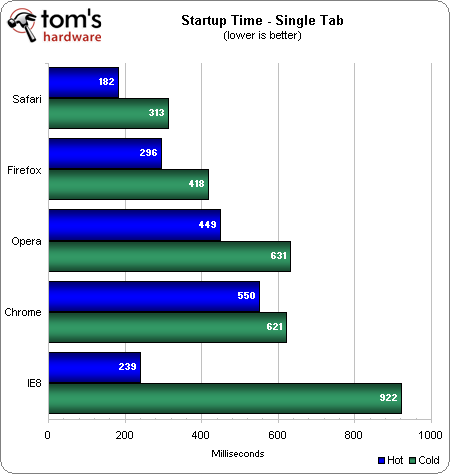

- Add new comment
- Read more
- 1359 reads
- Feed: Web Browsers News and Reviews
Battery Life: Internet Explorer 10 vs. Firefox 11 vs. Google Chrome 18 vs. Opera 11.6

Back in 2009 we have published an article on battery life, where Internet Explorer 8 pretty much dominated other web browsers; now, it’s time for a rematch.
By comparing top 5 web browsers battery life on a HP Pavillion laptop, 7tutorials found out the following…
Tested web browsers
Internet Explorer 10 Beta
Internet Explorer 9
Firefox 11
Google Chrome 18
Opera 11.62
Results
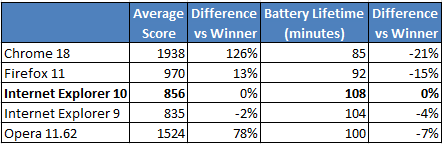
Conclusion
As seen in the results above, Internet Explorer 9 and 10 is still in the lead, followed by Opera, Firefox and lastly, Google Chrome.
So here you have it folks, switching from Google Chrome to IE10 alone would extend your battery life by you as much as 23 minutes.
- Add new comment
- Read more
- 1256 reads
- Feed: Web Browsers News and Reviews
Google Chrome, Firefox To Have A Metro Version For Windows 8

Opera looking into it.
Although it was previously known that Firefox will include a Metro like UI, the team behind Mozilla’s web browser only recently started the development. However, turns out, Google is also developing a Google Chrome Metro version, which will be available for the Windows 8 consumers.
In addition to Google’s announcement, the search giant has also confirmed that they will work on a touch optimized version of Google Chrome for the desktop.
What about other web browsers? Safari remains silent, however, ArsTehnica contacted Opera Software and received the following statement, “Unfortunately we can’t comment on any specifics yet, other than we are currently looking into Windows 8. The new OS and the Metro UI offers an interesting new platform and we know users will want to run Opera on it.”
We are curious to find out, how exactly will Google Chrome and Firefox differentiate themselves from the IE10 Metro, UI wise.
- Add new comment
- Read more
- 1139 reads
- Feed: Web Browsers News and Reviews

With each update, Facebook has gotten incrementally more cluttered, perplexing, and ornery—and I'm not even talking about all your annoying acquaintances flooding it with inane status updates. Yet, at the same time, it's become a tool few of us can live without. If Facebook has you on your last nerve, here's how to fix some of its biggest annoyances in a matter of minutes—and with only one new addition to your browser.
- Add new comment
- 1141 reads
- Feed: Lifehacker: Google Chrome
- 1
- 2
- 3
- 4
- 5
- next ›
- last »